Choosing the right Aluminum Extrusion Enclosure is not merely a matter of selecting a metal box. It is a design decision involving heat, protection, access, cost, and future maintenance. Grand View Research estimates that the global aluminum extrusion market could reach approximately USD 116 billion by 2030, supported by demand for lightweight, modular components. MarketsandMarkets also identifies electrical enclosures as a growing market, driven by industrial automation, renewable energy, and connected equipment.
That growth creates more options. It also creates confusion.
Jeff Henderson, president of the Aluminum Extruders Council, has emphasized that “extrusion allows designers to integrate function into the shape.” This principle matters when choosing an enclosure. A channel can hold a circuit board. A thick wall can improve rigidity. A removable side panel can reduce service time beside a machine.
However, these advantages are not automatic. Poor profile selection can leave unused internal space, sharp assembly constraints, or disappointing thermal performance. That is easy to overlook.
A practical evaluation should begin with dimensions, heat load, cable entry, mounting method, and environmental exposure. Check IP ratings under IEC 60529, and compare industrial requirements with NEMA 250 guidance. Do not assume a sealed enclosure is always better. Trapped heat can damage sensitive electronics, even when moisture stays outside.
The best Aluminum Extrusion Enclosure balances protection with accessibility. It should fit the equipment today and allow reasonable expansion tomorrow. Sometimes, the most expensive profile is unnecessary. Sometimes, it is the only responsible choice. This guide examines those trade-offs through real design conditions, supplier capabilities, and published industry evidence.
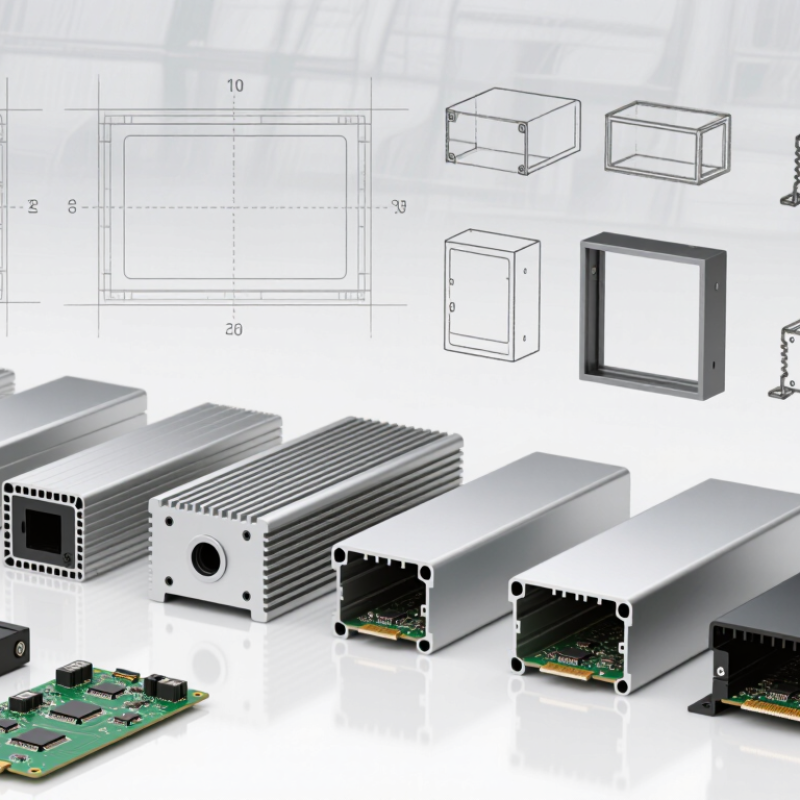
Choosing the right aluminum extrusion enclosure starts with a clear purpose. Will it protect control electronics, sensors, power modules, or a small display? Each application creates different demands. A workshop controller may need impact resistance and easy access. An outdoor instrument may require weather protection, sealed cable entries, and corrosion-resistant finishes.
Measure the equipment before selecting the enclosure profile. Record its width, height, depth, connector positions, and heat-producing components. Leave room for wiring and airflow. Crowded interiors make servicing difficult. They can also trap heat around sensitive parts. Check the expected load, vibration, humidity, dust, and temperature range. An enclosure near a machine may need stronger mounting points than one fixed inside a cabinet.
Protection ratings should match the real installation, not an optimistic estimate. Seal joints carefully, but do not block necessary ventilation without a thermal review. Aluminum conducts heat well, yet it does not solve every cooling problem. Internal insulation, surface treatment, and fan placement can change performance. I once underestimated cable bend space in a compact design. The enclosure fit, but the connectors did not. That small oversight caused unnecessary rework.
Consider how technicians will open the housing. Removable panels, captive fasteners, and clear grounding paths can improve maintenance. Confirm dimensional tolerances with measured drawings rather than assumptions. A prototype enclosure is useful. It exposes practical problems early. Needs change. Design reviews should allow for that.
| Requirement Dimension | Key Questions | Typical Selection Guidance | Recommended Specification | Verification Method |
|---|---|---|---|---|
| Application and Environment | Will the enclosure be used indoors, outdoors, in a vehicle, or in an industrial area? | Identify exposure to moisture, dust, chemicals, salt spray, vibration, and mechanical impact before selecting the profile. | Indoor: standard vented or non-vented design. Outdoor or industrial: sealed construction, corrosion-resistant finish, and suitable mounting hardware. | Create an environmental requirements list and compare it with the enclosure design and installation location. |
| Ingress Protection | How much protection is required against solid particles and water? | Use the required IP rating as a system-level target, including panels, gaskets, cable entries, fasteners, and joints. | IP54 for limited dust and water spray; IP65 for dust-tight protection and water jets; higher ratings require a validated sealing design. | Test or specify compliance with IEC 60529. Confirm that assembled components maintain the target rating. |
| Internal Dimensions | What are the dimensions of the PCB, power supply, connectors, wiring, and service clearances? | Allow space for cable routing, airflow, assembly tolerances, and future maintenance. | Allow approximately 10–20% additional internal volume beyond the initial component layout when practical. | Use a 3D CAD model or physical mock-up to check component clearance and access to mounting points. |
| Aluminum Alloy and Strength | Does the enclosure need lightweight construction, high stiffness, machining capability, or increased impact resistance? | 6063-T5 is commonly used for extruded profiles with good surface finish; 6061-T6 provides higher mechanical strength where required. | Select the alloy and temper according to load, profile geometry, machining requirements, and surface-finish expectations. | Review the material certificate and compare the alloy temper with the applicable aluminum material specification. |
| Wall Thickness and Profile Design | What loads will be applied by components, connectors, hinges, mounting brackets, and cable glands? | A thicker wall or reinforced profile may be needed for heavy components, repeated assembly, or large openings. | Use the thinnest profile that meets stiffness, thread engagement, impact, and machining requirements; verify the design structurally. | Check deflection, fastener pull-out, and mounting loads through calculation or mechanical testing. |
| Thermal Management | How much heat is generated inside the enclosure, and what is the maximum allowable component temperature? | Aluminum conducts heat well, but a sealed enclosure may require a larger surface area, heat spreader, thermal interface, or external heatsink. | Calculate the heat path from each heat source to the enclosure surface and evaluate the design at the maximum ambient temperature. | Perform thermal simulation or test at full rated load and worst-case ambient conditions. |
| EMI and EMC Requirements | Will the enclosure contain high-frequency electronics, switching power supplies, radios, or sensitive measurement circuits? | A conductive aluminum enclosure can provide shielding when seams, covers, cable entries, and grounding paths are properly designed. | Use continuous conductive contact or approved conductive gaskets at joints; control apertures and cable-entry shielding. | Conduct emissions, radiated immunity, and shielding-effectiveness tests according to the applicable product EMC standards. |
| Surface Finish and Corrosion Protection | Is appearance important, and will the enclosure face humidity, chemicals, abrasion, or salt exposure? | Anodizing provides a durable oxide layer; powder coating offers color variety and an additional protective coating when properly applied. | Specify finish type, color, coating thickness, masked areas, and corrosion-resistance requirements. | Check coating adhesion, visual uniformity, thickness, and corrosion performance using the applicable test method. |
| Mounting and Installation | Will the enclosure be mounted on a wall, panel, DIN rail, machine, vehicle, or desktop surface? | Mounting features must support the enclosure weight, internal equipment, cable forces, and vibration loads. | Define hole patterns, bracket type, orientation, allowable load, service access, and required clearance around the enclosure. | Verify fit with the installation structure and perform vibration or shock testing when required by the application. |
| Machining and Cable Entry | How many connectors, switches, displays, ventilation openings, and cable glands are needed? | Extruded aluminum is suitable for drilling, milling, tapping, and cutouts, but openings can reduce sealing and structural strength. | Finalize cutout drawings, hole tolerances, thread sizes, edge clearances, cable-bend radius, and sealing details. | Inspect first-article dimensions and perform a fit, cable-routing, and ingress check after assembly. |
| Safety and Compliance | Are there requirements for electrical safety, grounding, flammability, operator protection, or hazardous locations? | The enclosure must be evaluated as part of the complete product, not as an isolated component. | Define applicable regional and product standards, protective-earth provisions, clearance, creepage, and accessible-surface requirements. | Complete a compliance review and conduct required dielectric, grounding, temperature, and mechanical tests. |
| Serviceability and Lifecycle | How often will the enclosure need to be opened, repaired, upgraded, or cleaned? | Frequent service requires reusable fasteners, replaceable gaskets, accessible covers, and protection against thread wear. | Specify service intervals, gasket replacement requirements, fastener type, corrosion resistance, and spare-part availability. | Conduct repeated opening-and-closing, gasket compression, and maintenance-access evaluations. |
Start with the real load, not appearance. A compact control box may use 20 × 20 mm profiles. Wider doors may need 40 × 40 mm sections. Check deflection before ordering.
A 1.5 mm sheet may suit a small, protected enclosure. Larger panels often need 2.0–3.0 mm thickness. Hinges and cable entries deserve extra reinforcement.
Aluminum weighs less, but its elastic modulus is lower. Long panels may deflect noticeably under modest loads. Use ribs, shorter spans, or reinforcement.
Focus on corners, hinges, fasteners, and cable openings. Thick local plates or brackets can prevent movement. Thin central panels are not always the main problem.
Consider panel span, vibration, impact, fastener pull-out, heat, and corrosion exposure. Profile geometry also matters. Internal ribs can improve stiffness without adding excessive metal.
Measure the board, power supply, connectors, cable bends, brackets, and covers. Use internal dimensions. Leave space for ventilation, grounding, and maintenance access.
Reserve about 10–15 percent for future upgrades. Add clearance around connectors and cable bends. Small details can change the final fit.
Keep frequently used terminals near removable panels. Place heavy components low and close to support rails. Separate signal wiring from noisy power sections when practical.
Build a full-scale cardboard mock-up or create a 3D model. Mark every cable bend. Recheck tolerances after adding gaskets and protective covers.
No. Use deflection calculations or finite-element analysis, then test a physical corner sample. I once chose thick panels but ignored joint stiffness. The enclosure still moved.
Choosing the right Aluminum Extrusion Enclosure begins with clearly defining its purpose, operating environment, and protection requirements. Consider whether the enclosure will house electrical, industrial, or control components, then select an aluminum profile and wall thickness that provide sufficient strength, durability, and heat dissipation. The overall size and internal layout should allow enough space for components, wiring, ventilation, access, and future adjustments without creating unnecessary bulk.
It is also important to compare protection levels, cooling methods, and surface finish options according to the application. Sealing, ventilation, or added thermal management may be needed in demanding environments, while the finish should balance appearance, corrosion resistance, and cleaning requirements. Before finalizing the design, verify manufacturing tolerances, assembly methods, mounting points, and access features. Planning for inspection, replacement, and long-term maintenance will help ensure that the Aluminum Extrusion Enclosure remains reliable, practical, and cost-effective throughout its service life.

 HG Precision