How to Choose the Best Square Aluminum Railing?

Time:2026-09-07 Author:Aria
0%

Choosing the right Square Aluminum Railing involves more than matching a modern color to your home. The strongest decision balances safety, durability, comfort, installation quality, and long-term maintenance. A railing may look flawless in a showroom, yet perform poorly beside salty air, heavy rain, or frequent foot traffic. Details matter.

Daniel Hart, a railing systems engineer with more than two decades of field experience, explains, “A reliable railing should feel stable today and remain dependable after years of changing weather.” His advice reflects a practical standard for evaluating Square Aluminum Railing systems. Buyers should examine aluminum thickness, powder-coat quality, connection strength, post spacing, and fastener materials. Sharp corners deserve attention, especially around children and older adults. The handrail should feel smooth and natural under the palm.

Start with the installation environment. Coastal properties may need stronger corrosion resistance. Sloped decks require carefully adjusted posts and panels. Uneven surfaces can expose weak installation practices. Check the manufacturer’s testing information and warranty terms. Confirm that the selected system suits local building requirements and the deck’s structural condition.

A perfect choice does not exist.

Even premium aluminum can fail when installers rush measurements or ignore drainage. I have seen attractive railings loosen because the supporting surface was never inspected. That uncomfortable detail deserves attention. The best system is not always the cheapest or most decorative option. It is the one that fits the site, supports safe daily use, and remains easy to clean years later. This guide explores those practical decisions before you purchase.
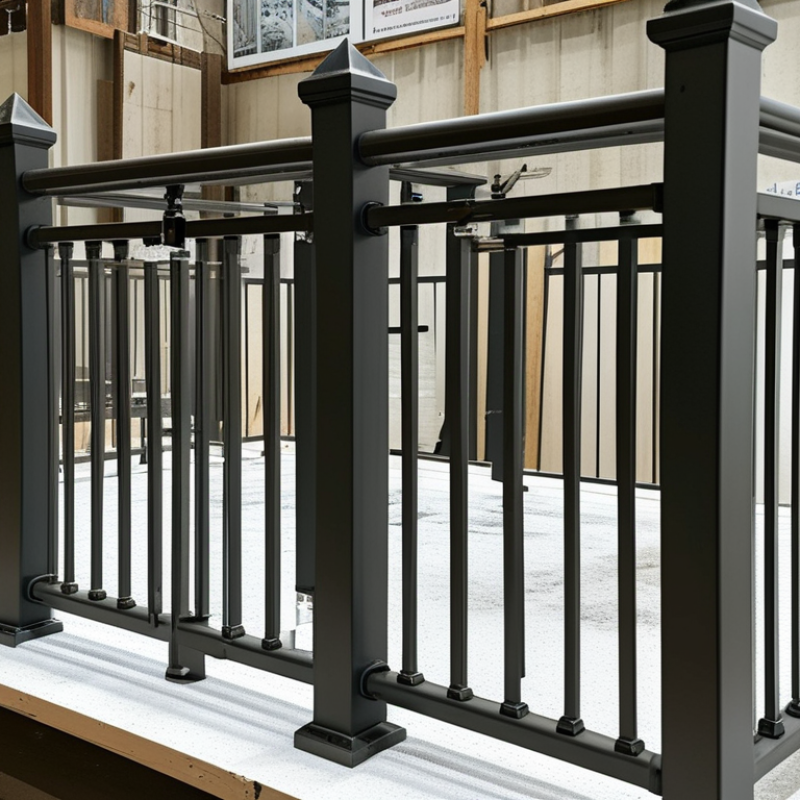
How to Choose the Best Square Aluminum Railing?

Define Railing Use: Residential 36 in or Commercial 42 in Guard Height

How to Choose the Best Square Aluminum Railing?

Define the railing’s use before choosing a square aluminum profile. For many residential decks, a 36-inch guard height is commonly used. Commercial areas often require a 42-inch guard because they face heavier traffic and greater fall exposure. These measurements usually run from the finished walking surface to the top of the guard, not from the framing below. Always confirm local building requirements before ordering materials, since height rules can vary by location and project type.

A square profile offers clean lines and predictable installation. Check the post wall thickness, anchor spacing, fastener quality, and infill openings. A taller commercial guard may also need stronger posts and more frequent supports. In field inspections, small measuring errors often create expensive rework. I have found that the finished surface is easy to overlook, especially after decking or tile is added. That detail deserves attention.

Tips: Measure after the floor surface is complete. Mark the 36-inch or 42-inch target clearly. Check stairs separately. Review wind, crowd, and maintenance conditions with a qualified installer. A 42-inch guard is not automatically safer for every home; it may feel oversized near low windows or compact balconies. Choose square aluminum with a durable finish, but inspect cut edges and drainage points carefully. Small details matter.

Select 6063-T5 Aluminum Profiles to Meet ASTM B221 Material Standards

Choosing the best square aluminum railing starts with its material specification. 6063-T5 aluminum profiles offer a practical balance of strength, formability, and corrosion resistance. The T5 temper means the profile is artificially aged after extrusion cooling. This improves its mechanical performance.

ASTM B221 covers extruded aluminum profiles and establishes requirements for alloy, temper, dimensions, and testing. Ask for a mill test report that clearly lists 6063-T5 and confirms ASTM B221 compliance. Do not rely on a generic “architectural aluminum” description. It may hide important differences. ASTM B221 covers the material, not the complete railing system. Posts, brackets, fasteners, and installation still need separate engineering checks.

Inspect the square profile closely. Clean corners, consistent wall thickness, and accurate dimensions help create stable connections. A thin wall may reduce weight, but it can also limit screw engagement. Check this before approving the drawing. Surface finish deserves attention too. Powder coating can improve appearance and weather resistance, yet damaged edges may expose the aluminum beneath. In coastal areas, use compatible stainless fasteners and prevent trapped water inside the posts. One overlooked drain hole can cause problems later. I would also request sample sections before ordering a large quantity. Small imperfections become expensive when repeated across an entire balcony.

Verify 200 lb Concentrated Loads and the 4 in Sphere Safety Rule

How to Choose the Best Square Aluminum Railing?

A reliable square aluminum railing must resist more than everyday leaning. The 2024 International Building Code, Table 1607.1, specifies a 200-pound concentrated load for guards and handrails. The load applies at the top, in any direction. The 2024 International Residential Code, Section R301.5, uses the same benchmark. Test the complete assembly, not only the aluminum profile. Posts, brackets, fasteners, and the supporting deck must share the force. A strong-looking rail can still fail at its connections.

The four-inch sphere rule controls opening safety. IRC Section R312.1.3 generally requires openings to reject a four-inch-diameter sphere. Measure between balusters, beneath the bottom rail, and beside posts. Small construction gaps matter. A square profile does not automatically create a compliant guard. Check the approved installation spacing and the actual site dimensions. Local amendments may change requirements, so confirm them with the authority having jurisdiction. This step is often skipped.

Tips: Place a rigid four-inch test sphere against every opening. Use a calibrated load test when project risk is high. Inspect fasteners for movement after installation. Do not trust finish quality alone. It can hide weak anchoring. Record the test date, load direction, and observed deflection. A minor gap or loose bracket deserves a second review.

Compare Powder Coating to AAMA 2604 or AAMA 2605 Performance Standards

How to Choose the Best Square Aluminum Railing?

When selecting square aluminum railing, do not treat powder coating and AAMA standards as equal choices. Powder coating describes the application process. AAMA 2604 and AAMA 2605 describe tested performance requirements. A quality powder finish may satisfy AAMA 2604, while a premium formulation can meet AAMA 2605. The correct choice depends on sunlight, moisture, salt exposure, and expected service life.

AAMA 2604

AAMA 2604 generally suits residential projects with moderate weather exposure. It offers stronger color retention and corrosion resistance than standard powder coating.

AAMA 2605

AAMA 2605 requires more demanding performance, including improved resistance to fading, chalking, and weathering. It is often better for coastal homes, commercial walkways, and heavily exposed balconies.

Check the coating certificate, pretreatment details, film thickness, and warranty terms. Vague claims are not enough.

Tips

Inspect the square profile corners and weld areas closely. Thin coverage there can invite early corrosion. Ask whether the complete system, not only the powder, meets the stated standard. I once underestimated the effect of poor drainage around post bases. That small detail caused staining before the finish itself failed. Also, dark colors may heat more quickly and reveal fading sooner. AAMA 2605 can reduce this risk, but it cannot correct poor installation or neglected maintenance.

Choose Square Post Sizes, Infill Spacing, Hardware, and Installation Systems

How to Choose the Best Square Aluminum Railing?

Square aluminum railings look simple, but their performance depends on careful sizing. Choose post dimensions according to span, height, wind exposure, and local building requirements. A larger post may appear stronger, yet it can create unnecessary cost and visual weight. On-site measurements should confirm the actual opening, slab edge, and mounting surface before ordering materials.

Infill spacing affects both safety and appearance. Measure the clear gap between balusters, not the center-to-center distance. Keep openings within the limits required by local regulations, especially where children may be present. Select corrosion-resistant screws, bolts, and washers that match the railing environment. Coastal locations usually require more durable hardware. Mixed metals can cause corrosion, a detail that is easy to overlook.

Tips: Compare surface-mount, fascia-mount, and embedded installation systems. Surface mounts work well on sound concrete with accurate anchors. Fascia mounts can preserve walkway space but need strong edge protection. Embedded posts offer a clean look, though repairs become difficult later. Check drainage around each post. Small errors matter. I have seen attractive layouts fail because the base plate landed over a weak slab edge. A final load review by a qualified professional is worth the extra time.

How to Choose the Best Square Aluminum Railing? — Choose Square Post Sizes, Infill Spacing, Hardware, and Installation Systems
Selection Dimension Typical Options Recommended Data or Range How to Choose Installation and Compliance Notes
Square Post Size 1.5 × 1.5 in
2 × 2 in
2.5 × 2.5 in
Approximately 38 × 38 mm, 51 × 51 mm, or 64 × 64 mm outside dimensions. Use 1.5-inch posts for light-duty residential layouts when permitted by the engineered system. Choose 2-inch posts for a common balance of appearance, stiffness, and availability. Use 2.5-inch posts for higher loads, longer spans, taller rails, or a more substantial visual profile. Post size alone does not determine strength. Check alloy, wall thickness, post spacing, connection details, base attachment, and the required local design loads.
Post Wall Thickness Light, medium, or structural wall Common aluminum railing extrusions may use wall thicknesses of roughly 0.080–0.125 in, but the correct value depends on the tested or engineered assembly. Select the wall thickness specified by the system manufacturer or structural calculations rather than choosing by outside dimensions alone. Thicker walls generally improve resistance to bending and fastener pull-out, but the complete post-to-base and rail-to-post connections must also be rated for the application.
Post Spacing Short, standard, or reinforced spans Many residential systems use approximately 4–6 ft between posts, while actual allowable spacing varies significantly by profile, height, load, and mounting surface. Use shorter spacing for decks with higher exposure, taller guard sections, corner conditions, or flexible framing. Longer spacing should only be used when confirmed by engineering or tested system data. Measure the clear span between posts and account for corner posts, end posts, gate openings, stair transitions, and expansion movement.
Guard Height Residential and commercial heights 36 in is common for many residential guards. 42 in is commonly required for guards in many commercial or higher-occupancy applications. Choose the height based on the applicable building code, project type, and local authority requirements. Guard height is normally measured from the walking surface to the top of the guard. Stairs may have separate handrail and guard-height requirements.
Infill Type Square pickets
Horizontal rails
Glass panels
Decorative panels
Square aluminum pickets are commonly available in approximately 0.75–1 in profiles. Glass systems require dedicated glazing channels and gaskets. Choose pickets for a lightweight, traditional appearance; glass for unobstructed views; and horizontal or decorative infill only where permitted by the applicable safety rules. Infill must be securely retained against movement and must not create prohibited climbing features where local codes restrict climbable guard designs.
Infill Opening Vertical picket spacing
Panel openings
Stair openings
In many U.S. residential applications, openings are designed so a 4-inch-diameter sphere cannot pass through. Stair openings may have different limits, commonly based on a 4-3/8-inch sphere rule. Design the clear opening—not the center-to-center spacing—to meet the governing code. Account for picket width, mounting clips, and tapered stair geometry. Local regulations can differ. Confirm the required sphere test, especially for childcare facilities, pools, elevated decks, and commercial properties.
Top Rail Profile Square top rail
Rounded top rail
Integrated handrail
Common square top-rail sizes include approximately 1.5–2.5 in wide profiles. Handrails are typically designed for comfortable gripping rather than only visual matching. Use a square rail for a modern appearance. Choose a graspable handrail profile for stairs or wherever a separate handrail is required. Many codes place handrails at approximately 34–38 in above stair nosings or the walking surface, but the exact requirement depends on the jurisdiction and application.
Aluminum Alloy 6063-T5 or 6063-T6 extrusions
6061 structural components
6063 alloys are widely used for architectural extrusions. 6061 is often selected for components requiring higher structural strength or heavy-duty machining. Choose an alloy according to the engineered system, extrusion shape, finish requirement, and expected loading—not alloy designation alone. Verify the temper, mechanical properties, corrosion environment, and compatibility of all structural components before installation.
Surface Finish Anodized finish
Powder-coated finish
Mill finish
Anodizing creates an integral oxide layer. Powder coating provides a broad range of colors and a protective polymer surface. Mill finish is unfinished aluminum. Use anodizing for a metallic appearance and powder coating for color flexibility. Avoid leaving mill-finish aluminum exposed where appearance and corrosion resistance are important. Clean and prepare the aluminum according to the coating specification. Repair field damage with a compatible touch-up system.
Fastener Material 304 stainless steel
316 stainless steel
Coated structural screws
304 stainless steel is common in ordinary exterior environments. 316 stainless steel offers improved resistance in coastal or chloride-rich environments. Choose 316 stainless steel near seawater, swimming pools, deicing salts, or frequent moisture. Use fasteners with verified structural capacity for post bases and critical connections. Prevent galvanic corrosion by isolating dissimilar metals where needed. Follow the specified hole size, edge distance, embedment, and tightening method.
Post Base Attachment Top-mount base
Side-mount fascia base
Embedded post
Top-mount bases install on the deck surface. Fascia systems attach to the side of a structural rim or beam. Embedded posts are installed before or within concrete or masonry construction. Use top-mounting when sufficient deck width and structural depth are available. Choose fascia mounting to preserve deck space, provided the supporting structure can resist the design loads. Do not attach a guard only to decking boards or thin cladding. Fasten into adequately sized joists, beams, rim boards, concrete, or engineered blocking.
Concrete and Masonry Anchors Expansion anchors
Adhesive anchors
Through-bolts
Anchor selection depends on concrete strength, edge distance, embedment depth, cracking condition, and the required shear and tension capacity. Use anchors that are specifically approved for the substrate and exterior exposure. Adhesive anchors may be appropriate where edge distances or vibration make expansion anchors unsuitable. Follow the anchor manufacturer's hole-cleaning, curing, spacing, and torque requirements. Never assume a generic anchor has adequate guard-load capacity.
Deck and Wood Framing Structural blocking
Rim-joist reinforcement
Through-bolted bases
Guard posts often require localized reinforcement because concentrated lateral loads are transferred into the deck framing. Inspect joist size, spacing, rim-board condition, ledger connections, and blocking before selecting the base system. Install blocking and reinforcement as specified by the railing or structural design. A strong railing cannot compensate for an undersized or deteriorated deck frame.
Stair Railing System Angled picket rail
Adjustable brackets
Separate handrail
Stair components must accommodate the stair pitch while maintaining consistent clearances and a continuous graspable handrail where required. Choose adjustable brackets for variable stair angles and fixed brackets for standardized layouts. Confirm compatibility between stair posts, pickets, top rails, and handrails. Measure the stair angle before ordering. Check tread-to-infill openings, handrail continuity, returns, terminations, and required extensions at the top and bottom of stairs.
Expansion and Thermal Movement Fixed connections
Slotted connections
Expansion gaps
Aluminum expands and contracts with temperature changes more than many adjacent materials. Long continuous runs require movement to be considered. Use the movement details specified for the system, particularly on long balconies, rooftop decks, and exterior installations with large temperature swings. Do not overtighten connections intended to allow movement. Maintain the specified clearances at rail joints, infill sections, walls, and other fixed elements.
Load Verification Guard-line load
Concentrated load
Infill load
Typical building codes may specify guard loads such as a 200 lbf concentrated load at the top in many U.S. applications, but requirements vary by code and occupancy. Use the governing local code and the system's tested or engineered capacities. Verify the complete load path from the top rail through posts, anchors, and supporting structure. Load requirements are jurisdiction-specific. Obtain professional structural review for commercial, high-occupancy, elevated, coastal, or unusual installations.
Final Selection Checklist Code, structure, appearance, maintenance, budget Confirm post dimensions, wall thickness, post spacing, guard height, opening limits, hardware, substrate, finish, and installation method. The best square aluminum railing is the system that satisfies safety requirements, matches the architecture, fits the supporting structure, and can be maintained in the project environment. Before installation, verify measurements, substrate condition, approved drawings, hardware compatibility, drainage, clearances, and all local permit or inspection requirements.

FAQS

: What guard height is commonly used for residential and commercial railings?

: Many residential decks use a 36-inch guard. Commercial areas often use 42 inches. Local requirements can differ.

Where should guard height measurements begin?

Measure from the finished walking surface to the guard’s top. Measure after decking or tile is installed. A 36-inch target can shift after surface work.

Is a taller guard always safer for a home?

Not always. A 42-inch guard may feel oversized near low windows or compact balconies. Choose height according to use, location, and local rules.

What load should a complete railing assembly resist?

The complete assembly should resist a 200-pound concentrated load in any direction. Posts, brackets, fasteners, and the deck share the force. A strong profile can still have weak connections.

How can opening safety be checked?

A four-inch sphere should not pass through regulated openings. Check baluster gaps, bottom gaps, and spaces beside posts. Small gaps matter.

How should square posts and balusters be selected?

Consider height, span, wind exposure, and the mounting surface. Measure clear gaps between balusters, not center-to-center spacing. Larger posts may add cost and visual weight without solving every problem.

Which installation system suits a square aluminum railing?

Surface mounts suit sound concrete with accurate anchors. Fascia mounts save walkway space but need strong edge protection. Embedded posts look clean, but future repairs become harder.

What hardware and site details deserve inspection?

Use corrosion-resistant screws, bolts, and washers suited to the environment. Check mixed-metal contact, drainage, cut edges, and anchor movement. I have overlooked drainage before. I would recheck it today.

Conclusion

Choosing the best Square Aluminum Railing begins with identifying where and how it will be used. Residential projects commonly require a 36-inch guard height, while commercial applications often use a 42-inch height. Select durable 6063-T5 aluminum profiles that meet ASTM B221 material requirements, helping ensure consistent strength and reliable performance.

Safety and finish quality are equally important. Confirm that the railing system can withstand a 200-pound concentrated load and that infill openings do not allow a 4-inch sphere to pass through. Compare powder-coating options based on AAMA 2604 or AAMA 2605 performance levels, depending on the project’s exposure and durability needs. Finally, evaluate square post dimensions, infill spacing, corrosion-resistant hardware, mounting surfaces, and installation methods. A well-planned Square Aluminum Railing should combine structural security, code-conscious design, long-term weather resistance, and an appearance that suits the surrounding architecture.


Aria

Aria

Aria is a dedicated marketing professional with a deep passion for innovative strategies and a keen understanding of our company's product offerings. With a wealth of experience in the industry, Aria excels at crafting engaging content that highlights the unique features and benefits of our......